5 Real-World Scenarios Where a Private Note Saves the Day

James Whitfield
23 April 2026
5 Real-World Scenarios Where a Private Note Saves the Day
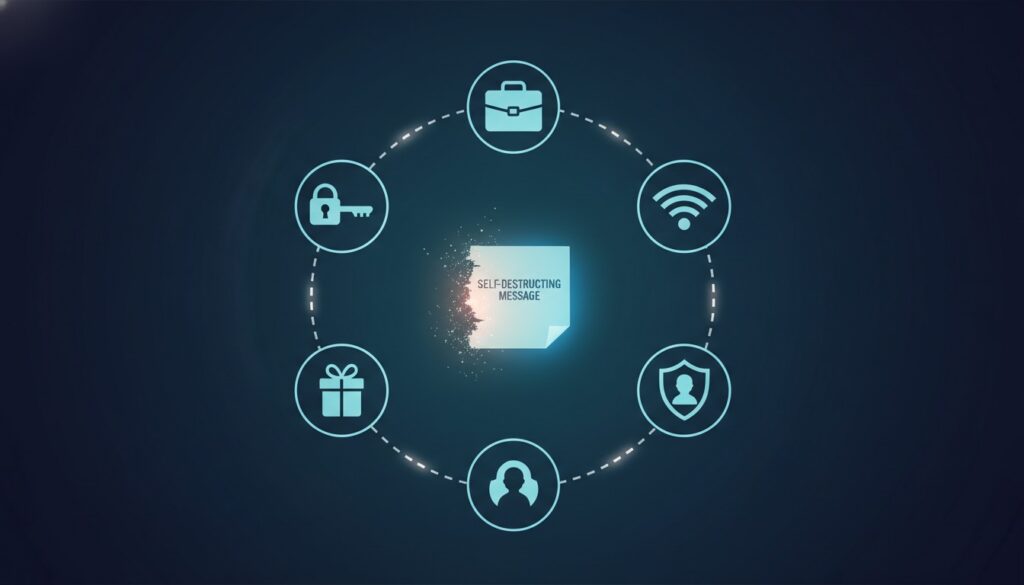
We live in a world where digital communication is constant — and yet, most of the tools we use to share sensitive information were never designed with privacy as a priority. Emails sit in inboxes forever. Text messages get backed up to the cloud. Chat logs persist on servers you don’t control. For the moments that truly matter — when the information you’re sharing is confidential, temporary, or simply not meant to last — a self-destructing private note can be a game-changer.
But when exactly would you need one? You might be surprised. Below, we explore five real-world scenarios where ephemeral, self-destructing notes don’t just add convenience — they genuinely save the day.
Scenario 1: Sharing Login Credentials with a Colleague or Client
The Problem
Imagine this: a new team member has just joined your project, and they need access to a shared staging server, a CMS dashboard, or a third-party analytics tool. What do most people do? They type the username and password directly into a Slack message, an email, or — worst of all — a sticky note on a desk.
The issue is clear: those credentials now live permanently in a searchable message history. If any of those platforms are ever compromised, your login details are exposed. Even if the credentials are later changed, the habit creates a dangerous pattern.
The Private Note Solution
With a self-destructing private note, you can:
- Generate a secure, one-time link containing the credentials
- Share that link via your preferred communication channel
- Rest assured that once the recipient opens the note, it is permanently destroyed
- Share preliminary deal terms or pricing in a note that vanishes after being read
- Communicate sensitive negotiation positions without leaving a paper trail
- Send confidential feedback on proposals that shouldn’t be part of the permanent record
- Mergers and acquisitions where information leaks can affect stock prices
- Freelancers and agencies sharing rate cards or custom pricing
- Legal professionals exchanging privileged communications
- Print the password on a card that stays visible indefinitely
- Text it to the guest, where it lives in their message history forever
- Shout it across the room (we’ve all been there)
- Automatic cleanup: Once the guest reads the note, it’s gone. No lingering credentials on their phone.
- Easy rotation: When you change your Wi-Fi password, you don’t have to worry about outdated credentials floating around in old messages.
- Professional polish: For Airbnb hosts or office managers, sending a clean, secure link feels more polished than a hastily typed text message.
- Your Social Security number for a loan application
- Your medical information with a new healthcare provider
- Your passport details for a travel booking
- Your bank account numbers for a wire transfer
- Share your SSN or tax ID with your accountant via a link that expires after one view
- Send passport details to a travel agent without leaving them in your sent folder
- Transmit bank account information for a one-time transfer with zero digital residue
- GDPR Article 5(1)(e) requires that personal data be kept “for no longer than is necessary”
- HIPAA’s Minimum Necessary Standard mandates limiting PHI exposure
- Self-destructing notes align naturally with these principles
- You’re planning a surprise birthday party and need to coordinate with friends — but the guest of honor has access to the family group chat
- You want to send a heartfelt, vulnerable message to someone without it sitting in a chat log forever
- You’re organizing a secret gift exchange and need to share assignments discreetly
- You want to share a private joke, confession, or thought that feels more meaningful because it’s fleeting
- Elevates the moment: The recipient knows this message is special because it won’t last
- Protects your vulnerability: Sharing something deeply personal feels safer when you know it won’t be screenshotted and shared
- Adds an element of intrigue: There’s an undeniable thrill in receiving a message that says “this will disappear after you read it”
- Set expiration times wisely. If you’re not sure the recipient will read the note immediately, choose a time-based expiration (e.g., 24 hours) rather than read-once destruction.
- Use password protection. For highly sensitive content, add a password to the note and share the password through a different channel.
- Don’t include context in the link message. When sharing the link, avoid writing something like “Here’s the server password.” Keep the surrounding message vague: “Here’s what you need” is sufficient.
- Verify the recipient. Before sending, double-check that you’re sharing the link with the right person. Once opened, the note is gone — there’s no undo button.
- Combine with other security practices. Self-destructing notes are one layer in a broader security strategy. Use them alongside strong passwords, two-factor authentication, and encrypted communication tools.
Pro Tip: Pair your private note with a password or PIN that you communicate through a separate channel (e.g., send the link via email and the PIN via text). This adds a layer of two-factor verification to your sensitive share.
Why It Matters
According to the 2023 Verizon Data Breach Investigations Report, over 80% of hacking-related breaches involve stolen or weak credentials. Minimizing the digital footprint of your passwords is one of the simplest and most effective security hygiene practices you can adopt.
Scenario 2: Sending Confidential Business Information During a Deal
The Problem
Business negotiations often involve the exchange of highly sensitive data: financial projections, contract terms, pricing strategies, intellectual property details, or acquisition targets. Sending this information through standard email creates a permanent, discoverable record that can be forwarded, leaked, or subpoenaed.
Even with NDAs in place, the practical reality is that once a document or message is in someone’s inbox, you’ve lost control over it.
The Private Note Solution
Self-destructing notes offer a practical middle ground between full transparency and total secrecy:
Important: Self-destructing notes are not a substitute for proper legal agreements. They are a complementary tool that reduces the risk of accidental exposure.
Real-World Example
A startup founder negotiating a seed round might use a private note to share their current revenue figures with a potential investor. The investor reads the note, the data disappears, and the founder retains control over who has permanent access to their financials. No screenshots can capture what isn’t expected, and no forwarding can spread what no longer exists.
Scenario 3: Sharing Wi-Fi Passwords and Access Codes with Guests
The Problem
Whether you’re hosting a dinner party, running an Airbnb, or welcoming a client to your office, sharing your Wi-Fi password is one of those mundane tasks that creates a surprising security risk. Most people either:
The Private Note Solution
Create a self-destructing note with your Wi-Fi network name and password, then share the link with your guest. Here’s why this approach is superior:
Hosting Tip: Create a private note that includes not just the Wi-Fi password, but also other useful guest information — door codes, parking instructions, emergency contacts — all in one ephemeral package.
Beyond Wi-Fi
This same principle applies to any temporary access code: alarm system PINs, gate codes, temporary building access credentials, or even locker combinations at a shared workspace. Any code that’s meant for temporary use deserves a temporary delivery method.
Scenario 4: Communicating Sensitive Personal Information
The Problem
Life regularly requires us to share deeply personal information digitally:
The Private Note Solution
Self-destructing notes are perfectly suited for this use case:
A Note on Compliance
For professionals handling personal data — accountants, financial advisors, healthcare providers — using self-destructing notes can also support compliance with regulations like GDPR, HIPAA, and SOC 2, which emphasize data minimization and limiting the retention of sensitive information.
Scenario 5: Sending Surprise Plans, Gifts, or Private Messages
The Problem
Not every private note scenario is about security in the traditional sense. Sometimes, you simply want to communicate something personal, heartfelt, or surprising without it becoming part of a permanent digital record.
Consider these situations:
The Private Note Solution
There’s something uniquely powerful about a message that can only be read once. It demands attention. It creates intimacy. It mirrors the way we communicate in person — where words are spoken, heard, and then exist only in memory.
Using a self-destructing note for personal messages:
Creative Idea: Use a self-destructing note as a modern-day love letter. Write something meaningful, share the link, and let the words exist for one beautiful, fleeting moment. It’s the digital equivalent of whispering.
Bonus Tips: Getting the Most Out of Self-Destructing Notes
Now that you’ve seen the scenarios, here are some best practices to maximize the effectiveness of private notes:
Conclusion: Privacy Is Not Paranoia — It’s Practical
The beauty of self-destructing private notes lies in their simplicity and versatility. They’re not just for spies and whistleblowers. They’re for anyone who has ever hesitated before typing a password into a chat window, or felt uneasy about their Social Security number sitting in someone’s email inbox.
From business credentials to personal confessions, from Wi-Fi passwords to deal-sensitive financials, the use cases are as varied as our daily lives. What they all share is a common need: the right information, to the right person, for the right amount of time — and not a second longer.
In a digital world that remembers everything, choosing to let something disappear is not just smart — it’s empowering.
Ready to Send Your First Private Note?
Don’t wait for a security scare to start protecting your sensitive information. Try creating a self-destructing note today — it takes just seconds, requires no account, and could save you from a data headache tomorrow.
Whether you’re sharing a password, sending a surprise, or simply valuing your privacy, ephemeral notes put you back in control of your digital footprint.
Create your first private note now and experience the peace of mind that comes with messages that truly disappear. 🔒